If you have been following AI lately, you have probably noticed that people often use AI agent and AI automation as if they mean the same thing.
- Some businesses call every chatbot an AI agent
- Some software vendors rename existing automations as AI agents
- Others assume that adding an AI model to a workflow automatically turns it into an agent.
The result is predictable: the more explanations you read, the harder it becomes to tell the two concepts apart.
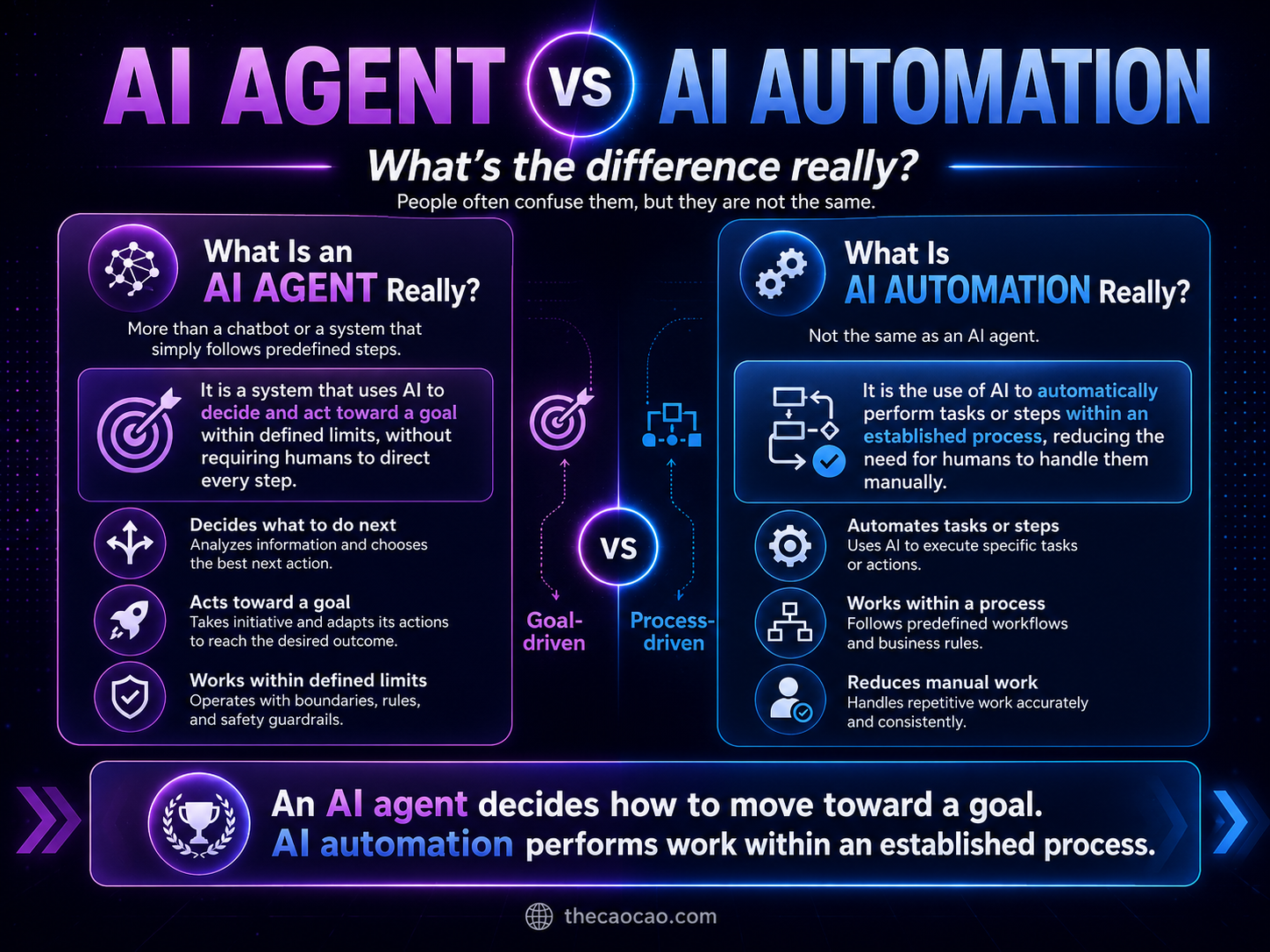
AI Agent vs AI Automation: What’s the difference, actually?
The problem is not that AI agents and AI automation are identical.
The problem is that many comparisons skip the definitions and jump directly into features, tools, and marketing claims.
Without clear definitions, it is difficult to know:
- whether your business needs AI automation or an AI agent
- why one system follows an established process while another can choose what to do next
- how AI agents, automation, and workflows are related
- or why an AI agent is not automatically better.
This guide starts with the definitions. Once the definitions are clear, the difference becomes much simpler.
What Is an AI Agent Really?
An AI agent is more than a chatbot or a system that simply follows predefined steps.
An AI agent is a system that uses AI to decide and act toward a goal within defined limits, without requiring humans to direct every step.
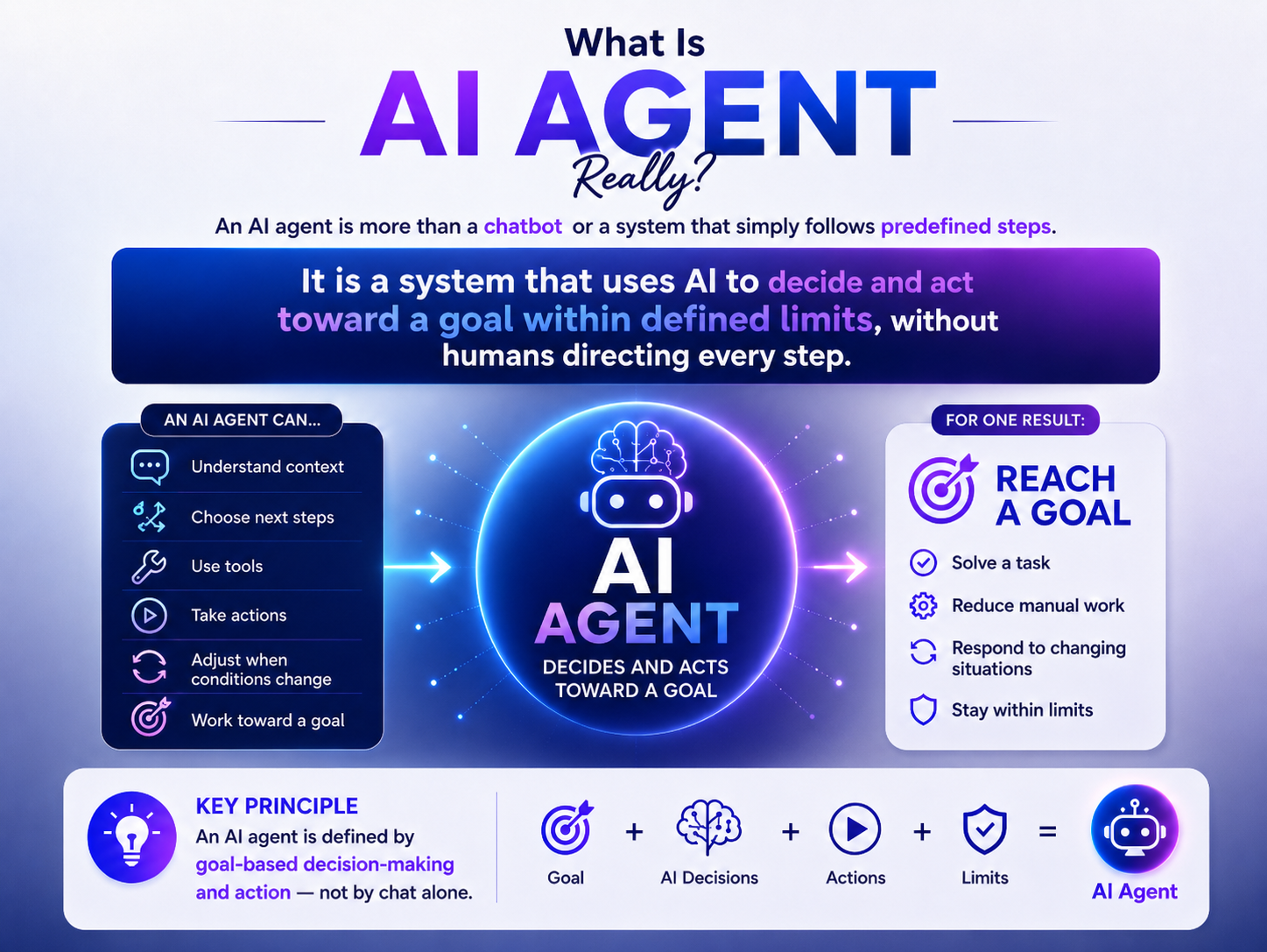
AI Agent definition – What is AI Agent actually?
The key idea is not that the system uses AI. Many tools and automations use AI.
What makes it an agent is that the system has some room to decide how to move toward a goal.
A human might define:
- the goal
- the rules
- the boundaries
- the permissions
- the available tools
- and when human approval is required.
The AI agent then uses those conditions to determine what action should happen next.
For example, imagine that you ask an AI system to resolve a customer complaint.
A basic chatbot may answer the customer’s question.
An automation may send a predefined response when a specific condition is met.
An AI agent may:
- read the complaint
- use the available tools
- check the customer’s order
- understand what happened
- continue until the task is resolved
- ask a human for approval when necessary
- choose whether to offer a replacement, refund, or escalation.
The human provides the goal and limits. The agent decides how to move through the task.
What can an AI agent do?
Depending on its design and permissions, an AI agent may be able to:
- understand context
- choose the next action
- use tools or software
- access information
- communicate with people or systems
- adjust when conditions change
- ask for human input
- and continue working toward a result.
This does not mean an AI agent has unlimited freedom. A useful agent should operate within clearly defined limits.
Its actions may be restricted by:
- access permissions
- company policies
- safety rules
- available tools
- budgets
- approval requirements
- or human oversight.
An agent is autonomous only within the space it has been given.
What Is AI Automation Really?
AI automation is not the same as an AI agent.
AI automation is the use of AI to automatically perform tasks or steps within an established process, reducing the need for humans to handle them manually.
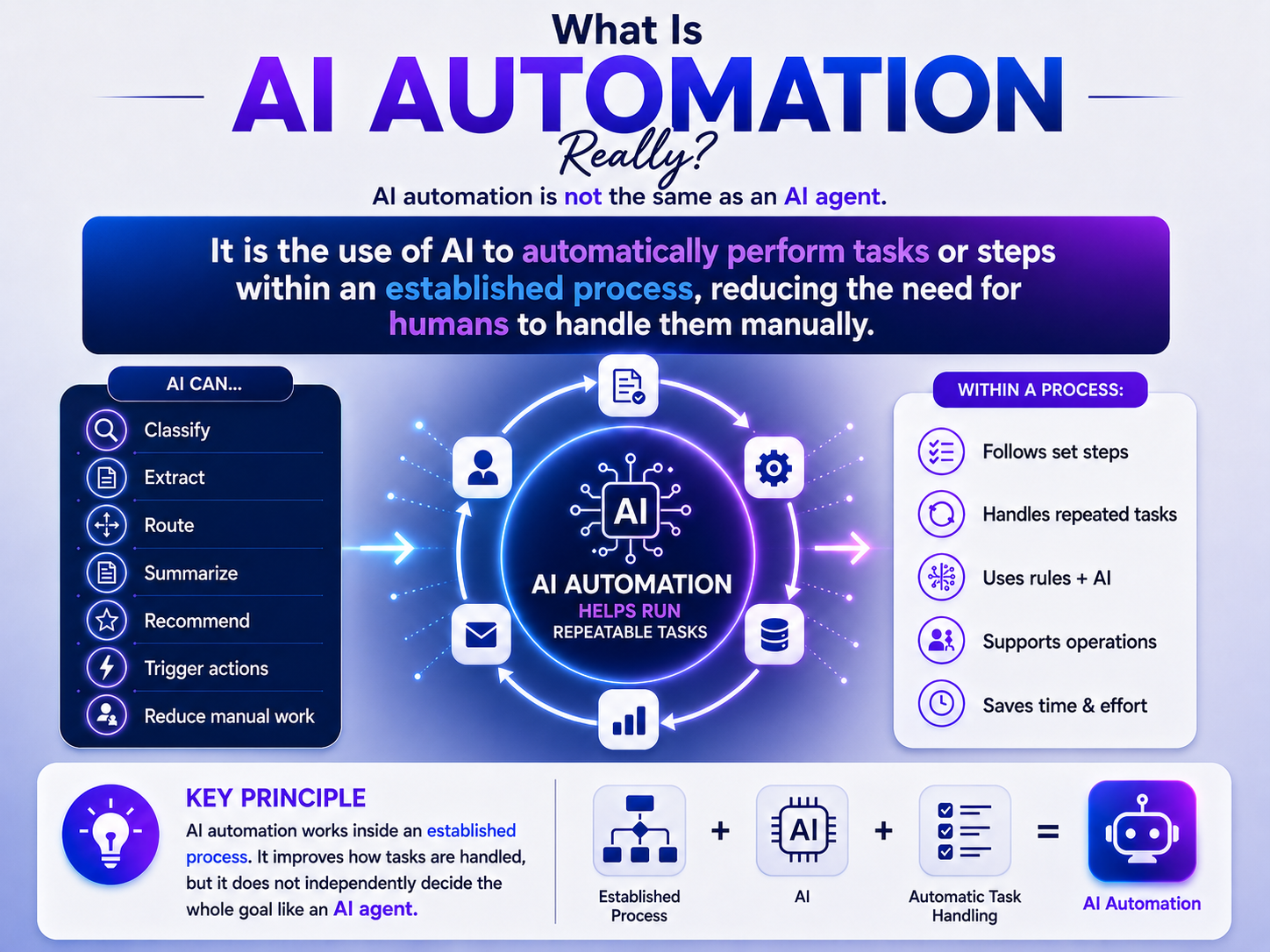
AI Automation definition – What Is AI Automation actually?
The process already provides the structure. AI helps perform one or more parts of that process.
For example, an invoice-processing automation may:
- receive an invoice
- extract the supplier name and amount
- classify the expense
- compare it with purchasing records
- send it for approval
- and update the accounting system.
AI may help read the document, classify the information, or detect unusual values. But the overall process has already been designed.
The system is not independently deciding what business goal should be pursued. It is helping execute work inside an established path.
What can AI automation do?
AI automation may be used to:
- classify emails
- extract information from documents
- summarize text
- route support tickets
- recommend a next step
- detect patterns
- generate content
- trigger actions
- update records
- and reduce repetitive manual work.
AI automation can still make decisions.
For example, it may decide whether an email belongs to sales, support, or billing.
- It may score a lead
- It may flag a transaction as unusual
- It may choose one predefined branch instead of another.
The important distinction is that those decisions happen inside an established process. The process still defines the overall path.
The Core Difference Between an AI Agent and AI Automation
The simplest distinction is: An AI agent decides how to move toward a goal. AI automation performs work within an established process.
- Both can use AI
- Both can take actions
- Both can reduce human work
- Both can make some decisions.
The difference is mainly about what guides the system.
AI agent
The goal guides the system.
The agent may choose:
- what to do next
- which tool to use
- which path to take
- whether new information changes the plan
- or when human input is needed.
AI automation
The process guides the system. AI may improve or perform specific steps, but the overall route has already been established.
A simple way to remember the difference is:
- Agent: Here is the goal. Decide how to move toward it.
- Automation: Here is the process. Help run it automatically.
AI Agent vs AI Automation Comparison
| Area | AI Agent | AI Automation |
| Starting point | A goal | An established process |
| Main role | Decides and acts toward the goal | Performs tasks or steps inside the process |
| Decision space | Can choose the next action within limits | Usually chooses among expected actions or branches |
| Adaptability | Can adjust its approach when conditions change | Adapts mainly within the process it was designed to support |
| Human guidance | Does not require humans to direct every step | Humans usually define the workflow and rules in advance |
| Best suited for | Dynamic, multi-step, less predictable work | Repeatable, structured, predictable work |
| Main risk | Poor decisions or actions if goals and limits are unclear | Automating a weak or incorrect process |
| Example | Investigating and resolving a customer issue | Classifying and routing customer tickets |
The table helps, but the definitions matter more than any individual feature.
A sophisticated automation may look agent-like. A limited agent may behave like an automation.
Do not classify a system only by its product name. Look at how it actually works.
Why Are AI Agents and AI Automation So Easy to Confuse?
The confusion usually comes from four places.
1. Both can use AI
A system does not become an AI agent simply because it uses a language model.
AI may be added to automation to:
- extract data
- understand text
- classify an input
- predict an outcome
- generate a response
- or choose a predefined branch.
That is still AI automation when the work remains inside an established process.
2. Both can take actions
An automation can send an email, update a database, create a report, or trigger another tool.
- Action alone does not define an agent
- An agent can also perform those actions.
The question is:
Is the system following an established path, or does it have room to decide which path should be taken?
3. Vendors use the term “agent” loosely
“AI agent” is currently a powerful marketing term.
- Others are chatbots connected to tools
- Some products described as agents are advanced automations
- Some are genuinely goal-driven systems with planning and action capabilities.
The label is not enough. The behavior matters.
4. Real systems often combine both
An AI agent may rely on automations. An automation may include an agent in one step.
A workflow may contain:
- human decisions
- traditional automation
- AI-powered automation
- and AI agents.
That is why the concepts overlap without being identical.
Common Misunderstandings
Cao Cao noticed several very common misunderstandings that people often have.
“Every chatbot is an AI agent.”
No. A chatbot that only responds to prompts is not necessarily an agent.
It may become part of an agent system when it can:
- work toward a goal
- choose actions
- use tools
- and continue without humans directing every step.
Conversation alone does not make something an agent.
“Any automation using AI is an AI agent.”
No. An automation can use AI while still operating inside a predefined process.
For example, an automated support system may use AI to classify incoming tickets.
That does not make the whole system an agent.
“AI automation cannot make decisions.”
This is also wrong. AI automation can make decisions inside an established process.
It may classify, rank, recommend, detect, or choose among predefined paths.
The difference is not that automation makes no decisions.
The difference is that the overall process still defines how the work moves forward.
“AI agents do not need humans.”
AI agents still need humans to define:
- goals
- boundaries
- permissions
- success conditions
- and escalation rules.
They may need less step-by-step guidance, but they should not operate without oversight in every situation.
“AI agents are always better than automation.”
No. An agent introduces more flexibility, but also more uncertainty.
For predictable work, automation is often:
- simpler
- cheaper
- easier to test
- easier to control
- and more reliable.
The most advanced option is not always the correct option.
When Should You Use AI Automation?
Use AI automation when the work has a clear and repeatable structure.
It is usually the better choice when:
- the steps are already known
- inputs and outputs are predictable
- the process changes rarely
- reliability matters more than flexibility
- decisions can be defined in advance
- or the main goal is reducing repetitive manual work.
Good examples include:
- extracting data from invoices
- classifying incoming emails
- routing support tickets
- generating standard reports
- updating customer records
- checking documents for missing information
- sending reminders
- and summarizing repeated types of content.
In these cases, the business already knows what the process should be. AI helps the process run faster or handle information that previously required human attention.
When Should You Use an AI Agent?
Use an AI agent when the work is more dynamic and the correct next step cannot always be predefined.
An agent may be useful when:
- the system must work toward a goal
- different situations require different paths
- the task may involve multiple tools
- new information may change the plan
- the system needs to choose what to do next
- or constant human direction would defeat the purpose.
Good examples include:
- investigating customer problems
- researching a topic across multiple sources
- coordinating tasks between systems
- managing a multi-step sales follow-up
- monitoring an operation and responding to changes
- helping employees complete complex internal tasks
- or planning and executing work across several tools.
An agent is most useful when flexibility has real value. Do not use one simply because “agent” sounds more advanced.
Real Examples
Customer support
-
AI automation
A customer submits a ticket.
AI classifies the ticket, assigns a priority, and routes it to the correct team.
The path is established.
-
AI agent
A customer reports that an order never arrived.
The agent checks the order, reviews tracking information, asks the customer a question, decides whether to contact the carrier, and offers a resolution within company policy.
The system chooses how to move toward resolution.
Content operations
-
AI automation
A workflow sends a draft to an AI model for summarization, applies a template, and schedules the result for review.
The steps are predefined.
-
AI agent
The agent receives a research goal, finds relevant information, identifies missing evidence, chooses which sources to inspect, creates a draft, evaluates whether the goal has been met, and asks for human review when necessary.
The system has more room to choose the path.
Sales
-
AI automation
When a lead submits a form, AI scores the lead, updates the CRM, and sends the correct email sequence.
The process is already defined.
-
AI agent
The agent reviews the lead, researches the company, identifies likely needs, chooses an outreach strategy, drafts a personalized message, and adjusts the next action based on the response.
The agent works toward the goal of progressing the opportunity.
Finance
-
AI automation
AI extracts information from invoices and sends exceptions to an employee.
-
AI agent
An agent investigates an unusual expense by checking related records, requesting missing information, comparing policy requirements, and escalating the case when needed.
Automation handles the known process.
The agent handles the less predictable investigation.
How AI Workflow, AI Automation, and AI Agents Are Related
A workflow is the larger structure, the overall path through which work gets done.
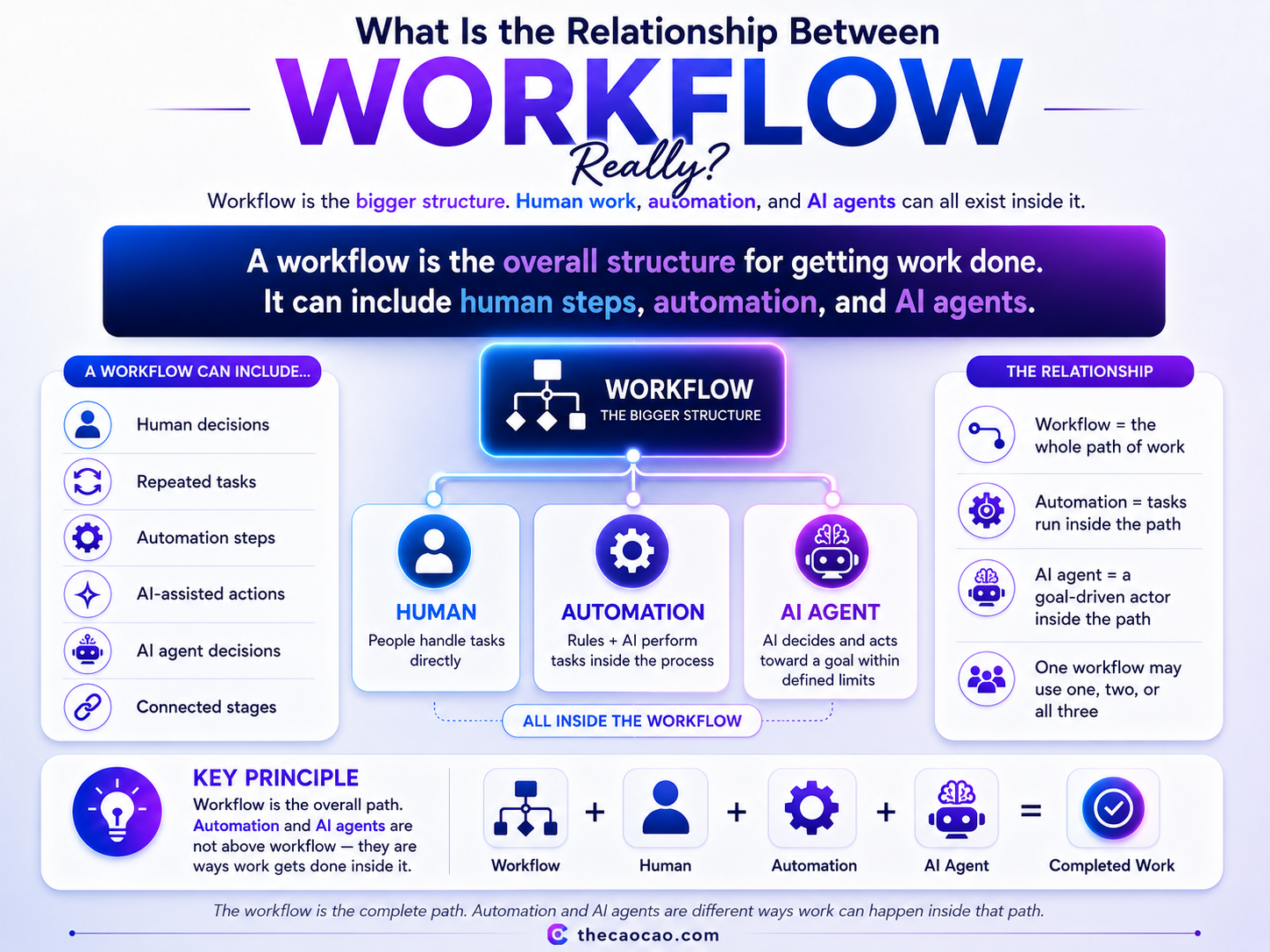
The workflow is the complete path. Automation and AI agents are different ways work can happen inside that path.
That workflow may include:
- Human
- AI Agent
- Automation.
A workflow does not have to use all three.
One workflow may be entirely human.
Another may be mostly automated.
Another may use an AI agent to manage several tasks.
For example, a customer-support workflow may include:
- automation receives and classifies the ticket
- an AI agent investigates complex cases
- a human approves refunds above a certain amount
- automation updates the customer record
- the agent checks whether the issue is fully resolved.
The workflow is the complete path.
Automation and AI agents are different ways work can happen inside that path.
This is why it is incorrect to treat “workflow,” “automation,” and “agent” as interchangeable labels.
They describe different parts of the system.
Can AI Agents and AI Automation Work Together?
Yes. In many useful systems, they should.
An AI agent does not need to manually perform every action. It can call automations to complete reliable, repeatable work.
For example, an agent may decide that a customer should receive a replacement.
The agent makes the decision.
An automation then:
- creates the replacement order
- sends the confirmation email
- updates the CRM
- and notifies the warehouse.
The agent provides flexible decision-making.
The automation provides consistent execution.
A practical system may therefore look like this:
Goal → AI agent chooses the next action → automation performs the task → agent evaluates the result.
This combination can be more useful than trying to make one system do everything.
How to Tell Whether a Product Is an Agent or Automation
Ignore the product label for a moment.
Ask these questions:
What starts the work?
- A predefined trigger usually suggests automation.
- A broader goal may suggest an agent.
Who decides the next step?
- If the workflow already defines the next step, it is closer to automation.
- If the system can choose among multiple possible actions, it is more agent-like.
Can the system change its plan?
- If it only follows expected branches, it is likely automation.
- If it can adjust the path based on new information, it may be an agent.
Does it use tools independently?
- Calling a tool does not automatically make it an agent.
- The important question is whether the system chooses when and why to use the tool.
What happens when the situation is unfamiliar?
- Automation may stop, fail, or send the case to a human.
- An agent may attempt a new path within its allowed limits.
How much human direction is required?
- Automation usually depends on more process design in advance.
- An agent may require less step-by-step direction during execution.
Most real systems exist on a spectrum.
The purpose of the definitions is not to force every product into a perfect box.
The purpose is to understand how the system behaves.
Which One Should Your Business Choose?
Choose AI automation when you already understand the process and mainly want to perform it more efficiently.
Choose an AI agent when the system must decide how to move toward a goal because the correct path may change.
Use both when:
- some parts of the work are predictable
- other parts require judgment
- and humans should remain responsible for sensitive decisions.
A good rule is: Automate predictable work first. Add agents where flexibility creates real value.
Do not begin with the most advanced technology.
Begin with the work that needs to be done.
The Difference in One Sentence
An AI agent decides how to move toward a goal. AI automation performs work within an established process.
That is the core difference.
An AI agent is guided mainly by a goal. AI automation is guided mainly by a process.
An agent may use automation. Automation may use AI.
Both may exist inside the same workflow.
The correct choice depends on the work:
- use automation for predictable tasks
- use an agent for dynamic goal-driven work
- and combine them when the workflow needs both flexibility and consistency.
Once you understand that relationship, the labels become much less confusing.
Learn more about:
AI Agent vs AI Automation FAQs
Below are some very common questions that Cao Cao prioritizes answering first.
Is ChatGPT an AI agent?
ChatGPT by itself is primarily an AI assistant that responds to user prompts.
It can become part of an AI agent system when it is connected to:
- a goal
- tools
- memory
- permissions
- actions
- and a process that allows it to continue working without humans directing every step.
Can AI automation use generative AI?
Yes.
AI automation may use generative AI to:
- summarize
- rewrite
- classify
- extract
- generate responses
- or transform information.
Using generative AI does not automatically make the automation an agent.
Can an AI agent follow a workflow?
Yes.
An AI agent can operate inside a workflow.
The workflow defines the broader path of work, while the agent may handle one or more stages that require flexible decisions.
Is every AI workflow agentic?
No.
An AI workflow may include simple AI-powered automation without any agent.
A workflow becomes agentic only when an agent has meaningful freedom to decide and act toward a goal.
Is AI automation always based on fixed rules?
Not always.
AI automation can use models that classify, predict, recommend, or choose among different branches.
However, those capabilities still operate within an established process.
Are AI agents fully autonomous?
Usually not.
Most useful AI agents operate with:
- permissions
- tool restrictions
- policies
- human approval
- and safety limits.
They may be autonomous within a defined area, not autonomous without boundaries.
Which is safer: an AI agent or AI automation?
AI automation is generally easier to predict because its process is more established.
AI agents can handle more dynamic work, but they require stronger controls, monitoring, and oversight.
The safer choice depends on the task and the consequences of a mistake.
Do small businesses need AI agents?
Not always.
Many small businesses can create significant value with simple automation first.
An AI agent becomes useful when the business has a real problem that requires flexible, multi-step decisions.