AI content is not content created by humans alone. It is any content created with AI to help generate, improve, or transform content to meet user needs.
The quality of AI content depends not only on AI itself, but also on the AI model and how people use it.
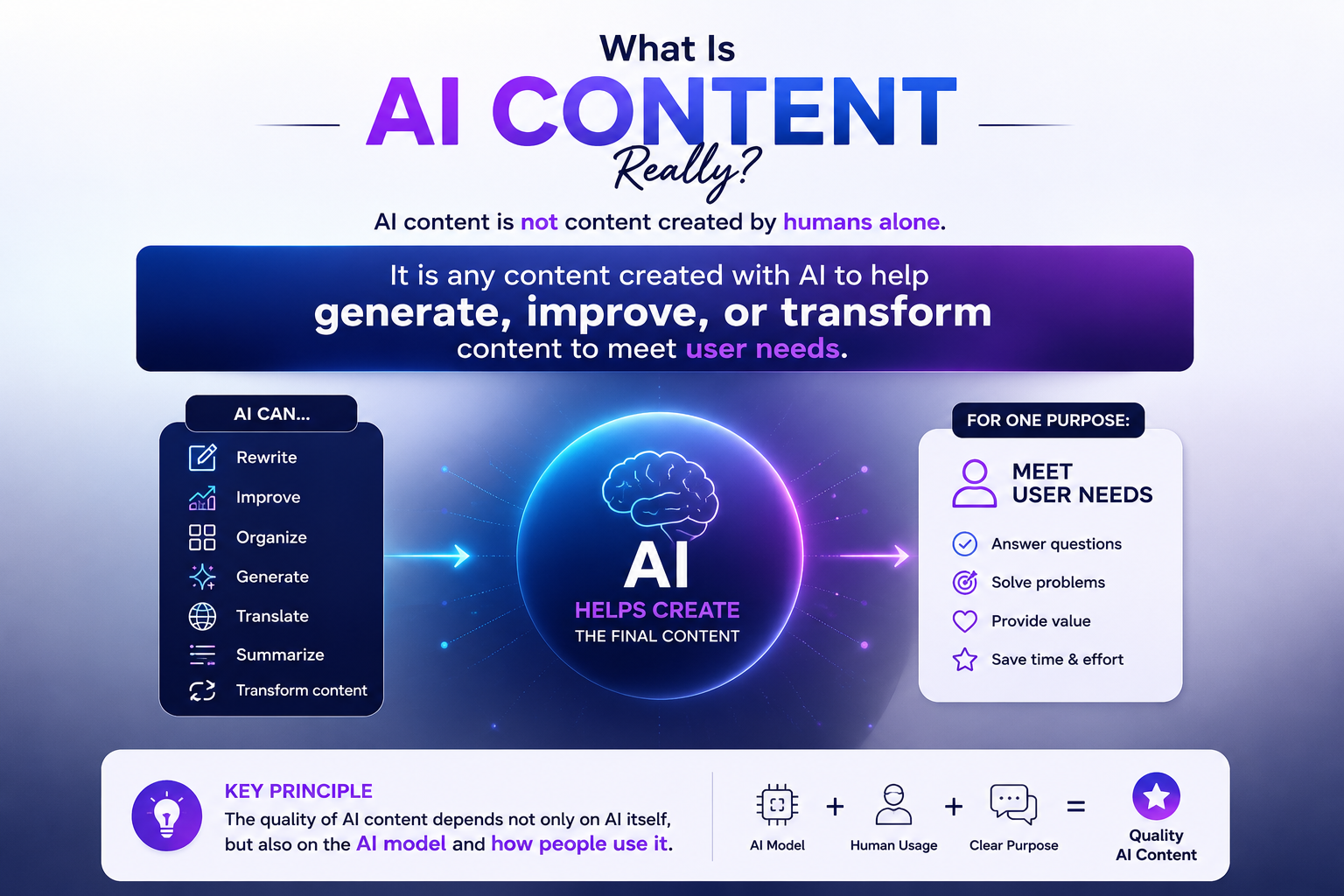
AI content definition – What is AI content actually?
AI content has quickly become one of the most common terms in the AI era. Yet despite its popularity, there is still no widely accepted definition.
Many websites simply describe AI content as content written by artificial intelligence. While that definition was once useful, it no longer reflects how AI is actually used today.
AI is no longer limited to writing articles from scratch. It now helps people:
- rewrite
- improve
- organize
- generate
- translate
- summarize
- or transform content…
across almost every industry.
Understanding what AI content really means is important because it changes how we evaluate content, choose AI tools, and decide where human creativity still provides the greatest value.
Why Is AI Content So Difficult to Define?
One reason is that AI develops much faster than traditional definitions.
A definition written a year ago may already feel outdated because AI capabilities continue to expand.
Another reason is that people often confuse AI-generated content with AI content.
If AI writes an entire article, everyone agrees it is AI content.
- What if AI translates a document?
- But what if AI only rewrites a paragraph?
- What if AI reorganizes a report without changing its meaning?
These situations show that defining AI content only as “content written by AI” is no longer enough.
What Actually Makes Content Become AI Content?
Many people ask:
Who created this content?
A better question is:
Did AI meaningfully contribute to creating the final content?
If the answer is yes, the content falls within the broader idea of AI content.
AI can contribute by helping people:
-
write drafts
- improve clarity
- translate languages
- generate new ideas
- organize information
- summarize information
-
rewrite existing content
-
transform one content format into another.
Although these tasks are different, they all share one common purpose.
AI helps create the final content.
That contribution—not whether AI wrote every word—is what defines AI content.
What AI Content Is NOT
Please don’t misunderstand:
-
AI content is NOT only content written entirely by AI
Many people imagine AI content as an article produced with a single prompt.
In reality, AI often assists people throughout the creation process instead of replacing it completely.
-
AI content is NOT automatically low quality
Poor AI content usually reflects poor instructions, poor editing, or choosing the wrong AI model.
Likewise, excellent AI content usually combines capable AI with thoughtful human guidance.
-
AI content is NOT automatically better than human content
Using AI does not guarantee better results.
Content only becomes valuable when it solves real problems and meets user needs.
-
AI content is NOT determined by who publishes it
Whether content is published by a company, an individual, or an AI platform does not determine whether it is AI content.
What matters is how AI contributed during the creation process.
What Determines the Quality of AI Content?
According to the definition above, AI content quality depends on three major factors.
-
The AI model
Different AI models produce different results.
- Some models are better at reasoning
- Others are better at writing, coding, translation, or image generation.
Choosing the right model directly affects content quality.
-
Human guidance
AI follows instructions.
People decide:
- what tone to use?
-
what problem to solve?
-
what should be reviewed?
-
what should be removed?
-
what information matters?
Good AI content almost always reflects good human judgment.
-
Purpose
The purpose of AI content is not simply to create content faster.
Its real purpose is to help people create more useful content that better meets user needs.
Speed is only a benefit, helping users remains the goal.
Types of AI Content
The same definition applies regardless of content format.
AI content may include:
| Type | Examples |
|---|---|
| Text | Articles, emails, reports |
| Images | Illustrations, graphics |
| Video | Short videos, animations |
| Audio | Voiceovers, podcasts |
| Code | Software, scripts |
Although these formats are different, they all become AI content when AI meaningfully contributes to creating the final result.
AI Content vs Human Content
AI content and human content are often presented as competitors.
In reality, modern content usually combines both.
Imagine a spectrum. Entirely Human → Human + AI → Mostly AI → Entirely AI
Most real-world content falls somewhere in the middle.
The important question is not:
Which one is better?
Instead, ask:
How much value does each contribute?
That question leads to better decisions than treating AI and humans as opposites.
Why AI Content Matters
A clear definition benefits everyone.
- Businesses can build better workflows
- Educators can teach AI more accurately
- Creators can choose AI more effectively
- Marketers can create clearer SEO/SEO content
- Everyday users can better understand the content they consume.
Without a clear definition, discussions about AI content often become debates about tools instead of conversations about value.
Conclusion
AI content is not defined by whether AI writes every word.
It is defined by AI’s meaningful contribution to creating the final content.
As AI becomes part of everyday work, understanding AI content is no longer optional. It is the foundation for evaluating AI fairly, using AI responsibly, and creating content that genuinely meets user needs.
That’s why a clear definition matters.
The future of AI content will not be decided by AI alone. It will be decided by the people who know how to use AI and create AI workflows well.
⚠️ One last reminder from Cao Cao: the quality of AI content depends not only on the AI model you use, but also on how you use it. AI is only a tool—people still determine the final quality.
——
Frequently Asked Questions (FAQs)
-
What is AI content?
AI content is any content created with AI to help generate, improve, or transform content to meet user needs.
-
Is AI-generated content the same as AI content?
No. AI-generated content is one type of AI content. AI content also includes content that AI helps improve, rewrite, summarize, organize, or translate.
-
Can AI content be high quality?
Yes. High-quality AI content depends on the AI model, human guidance, and whether the final content meets user needs.
-
Can AI completely replace human content?
AI can automate many tasks, but people still provide judgment, context, creativity, and decision-making that AI cannot consistently replace.
-
Is chatGPT content AI content?
Yes.
If ChatGPT meaningfully helps generate, rewrite, improve, summarize, translate, or transform content, the final result is AI content.
The quality of that content depends on the AI model, human guidance, and whether it meets user needs.
-
Is rewritten content AI content?
Usually, yes.
If AI meaningfully rewrites, reorganizes, improves, or transforms existing content, the final result is still AI content.
AI content is defined by AI’s contribution to creating the final content—not by whether it starts from a blank page.
-
Can AI content rank on Google?
Yes.
Google evaluates content based on its usefulness, quality, and ability to satisfy users—not simply on whether AI helped create it.
High-quality AI content can rank well if it provides accurate, helpful, and valuable information.
-
Is AI content copyrighted?
It depends.
Copyright laws vary by country, and AI-generated content may not always receive the same legal protection as entirely human-created work.
When AI assists people during the creation process, copyright usually depends on the level of meaningful human contribution and the laws of the relevant jurisdiction.
-
Is AI-generated content the same as AI content?
No.
AI-generated content is one type of AI content.
AI content also includes content that AI helps rewrite, improve, summarize, translate, organize, or transform. Not every piece of AI content is created entirely by AI.
-
Can human-edited AI content still be AI content?
Yes.
Editing AI-generated content does not automatically make it human content.
If AI played a meaningful role in creating the final content, it still falls within the broader definition of AI content.